The E28 needed just 282bhp to make it the world’s fastest series-production four-door. Just over 2000 were hand-built between 1985 and 1988. But close to 50,000 M5s have been built since, over four model generations.
BMW has 'downsized' the engine of its go-faster saloon
The idea of regression may be disagreeable, but it applies to the new F10-generation BMW M5 super-saloon whether BMW likes it or not. Never before has its Motorsport division replaced a go-faster saloon with one packing fewer cylinders than its direct antecedent. Never before has it shunned a bigger, clean-revving, normally aspirated lump for ‘downsized’ turbocharging in one of its “blue chip” performance saloons. Until now.
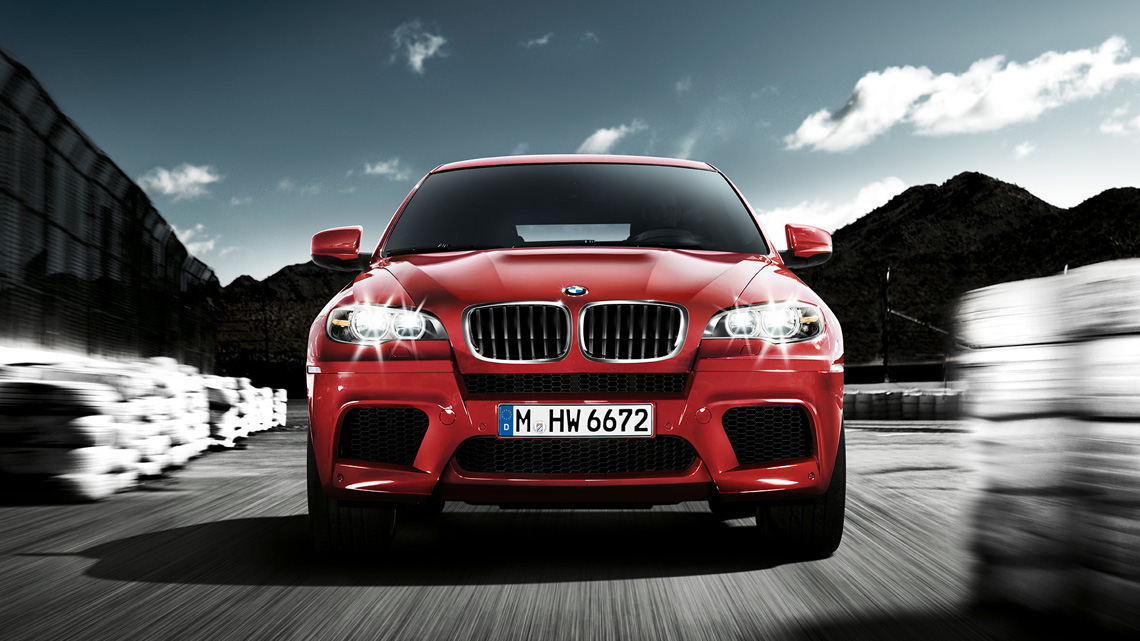
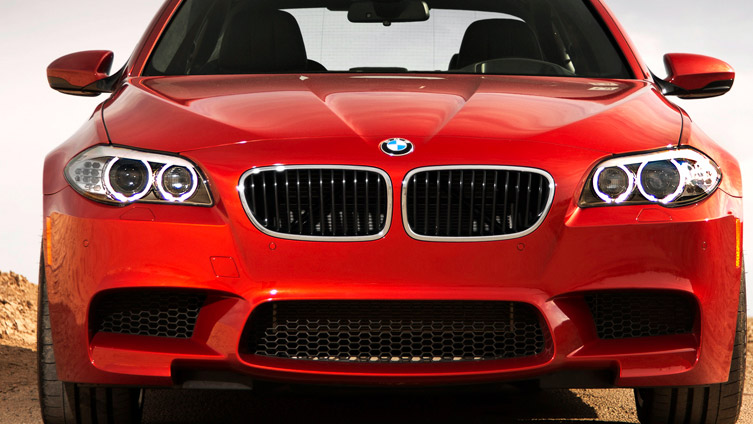
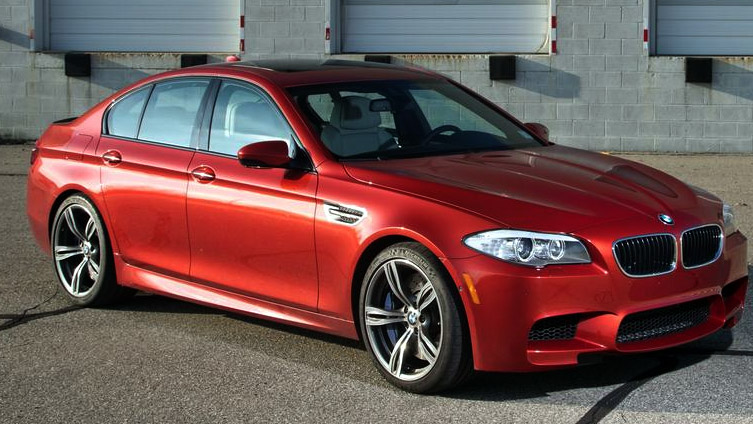
Upholding the traditions of so many of BMW Motorsport’s specials, the new M5’s styling is anything but overblown. Its extended side sills and modest bootlid spoiler are typically understated. Adding a note of visual purpose, trademark quad exhaust pipes poke out from under a deeper rear valance. At the front, larger and wider air ducts feed 10 radiators.
it offers 10 per cent more power than the outgoing V10 and - they say - has the high-rev fireworks and throttle response of one of BMW M's finest
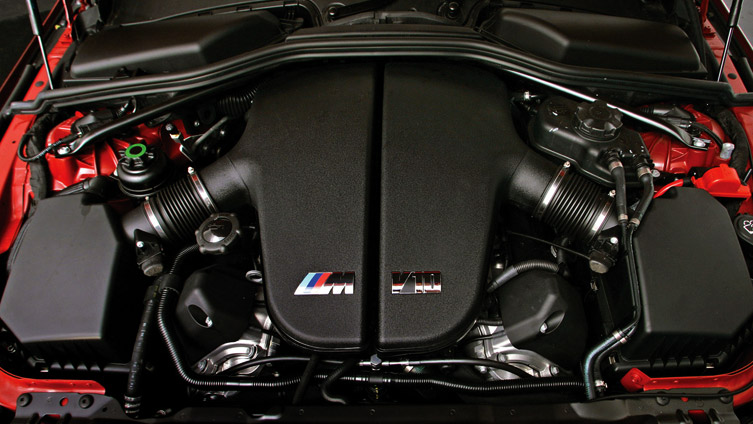
Which brings us to the rather controversial contents of the M5's engine bay: a 4.4-litre, all-aluminium 90deg V8 fed by two twin-scroll Honeywell turbochargers packaged between the cylinder banks. The engine runs direct injection working at up to 200bar of pressure, as well as Valvetronic variable valve lift and double Vanos variable camshaft timing. Making 552bhp between 6000rpm and 7000rpm and revving at up to 7200rpm, it offers 10 per cent more power than the outgoing V10 and - they say - has the high-rev fireworks and throttle response of one of BMW M's finest.
This V8 also produces 502lb ft between 1500rpm and 5750rpm - 30 per cent more torque than the last M5, accessible over a band of revs three times as wide. It's also 30 per cent more fuel efficient than the old V10 and, fed from an 80-litre fuel tank, should contribute to a 50 per cent improvement in cruising range.
Instead, the M5 uses electro-hydraulic power steering and a strong, light, robust but simple suspension. Like the standard car's chassis, it's made up of double wishbones up front and multi-links at the rear. There's a wider front track than standard, as well as new forged aluminium chassis members, progressive rate springs and adaptive dampers.
Sheer mass is the only minor disappointment on the spec sheet; our test car weighed in at 1975kg with fuel.
Outstanding quality and luxury, genuine everyday usability, long-distance touring comfort for four occupants... these, too, are ways in which a good super-saloon must distinguish itself these days. Class-leading performance and handling will only be enough for the BMW M5 if they come packaged with all of the above.
And the good news is that the new M5’s cabin is more impressive than ever

This five-seat express offers legroom and headroom that’s generous by the standards of its peers, along with soft extended merino leather as standard and a kit tally that includes adaptive bi-xenon headlights, BMW Professional sat-nav, a DAB radio and a head-up display.
The driving position is excellent, supported by wide sports seats with more adjustment than most will ever need. The cabin’s material quality and richness unerringly convince you that you’re aboard something luxurious, expensive and well built.
All that’s lacking are a few outstanding points of differentiation. Aside from some slightly transformed instruments, embossed leathers and sill plates, there’s little that adds piquancy to the regular 5-series’ business-like ambience.
If a test drive in the new M5 comes with a more interesting soundtrack than you were expecting, that may be because part of that mechanical soundscape comes from its audio speakers, not its engine compartment or its exhaust.
The M5’s Active Sound Design system reproduces the sound of the car’s V8 through the car’s audio speakers, at various background volumes and frequencies decided on the basis of engine revs, throttle load and road speed data taken ‘live’, directly from the ECU.
During our tests, it proved impossible to distinguish between real and reproduced engine sound.
We knew the BMW M5 would have a great deal of performance. We just weren‘t quite prepared for the incredible reality of its accelerative potential. Or for the fact that, on another day, it might have been faster still.
The new M5 isn‘t an easy car to get away from a standstill with optimum thrust. If you‘re too aggressive with the throttle, you‘ll activate the DSC stability control and lose a lot of momentum. If you turn the DSC off completely, it‘s equally easy to spin almost all of the engine‘s power away. And with 502lb ft coursing through them, once those rear tyres lose their hold on the road, it takes more than a feather of the accelerator before they‘ll bite again.
The M5 has genuinely brutal, apparently limitless thrust
As part of our two-way standing start test, on a slightly damp day, the M5 recorded an average 4.3sec sprint to 60mph, and 100mph came up in 9.0sec dead, which is more than a second sooner than it did in the Jaguar XFR we tested in 2009, and almost a second quicker than Mercedes‘ current CLS63 AMG. And that was all without the help of BMW M‘s launch control system – which, despite repeated efforts, simply refused to engage under test conditions.
It‘s fast, then – prodigiously so. And the seven-speed, dual-clutch M DCT transmission is the M5‘s next greatest success story. It endows the car with relaxed usability to match its superb at-pace precision. It will remain in auto mode whichever of the powertrain presets you choose, but nudge one of the standard wheel-mounted paddles and it will shift to manual, in which state it will hold its gears as expected and swap ratios on command with impressive response and precision.
Also, there‘s a low-speed assistance mode via which you can make the M5 creep at ideal manoeuvring speed with a quick stab of the accelerator. This will make this M5 significantly easier to live with (read, park) than the last.
Don’t believe the rumour mill: BMW hasn’t softened the M5 to the detriment of its ability to cope when really driven hard – either on a testing road or a circuit. True, there is surprising comfort, refinement and ease of use to be enjoyed with this car – a great deal more than you’ll find in most 500bhp super-saloons.
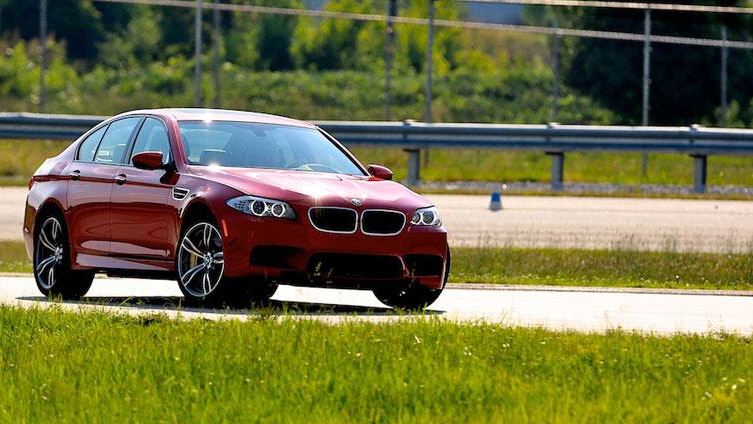
Don’t believe the rumour mill: BMW hasn’t softened the M5 to the detriment of its ability to cope when really driven hard
That’s the key advantage of BMW M’s multi-mode suspension, steering and powertrain control systems. But thanks to the same systems, there’s also breathtakingly firm damping and a highly responsive engine and gearbox when you select Sport+ mode. And – for anyone who’s wondering – turbo lag isn’t the slightest problem.
It’s a pity, though, that there isn’t more delicacy or reward to be found in between those two extremes of the M5’s repertoire. Because where a Jaguar XFR feels like a finely honed and deeply satisfying instrument when you’re simply bowling along at everyday speeds, the BMW keeps more of its dynamic majesty in reserve.
When you engage cruise control, the car reverts to Comfort mode
Select the suspension’s Comfort mode and, during normal road use, compliance comes without ever putting body control in doubt. There is some patter through the springs and slight fidgeting over very worn asphalt, but it’s hardly a compromise that anybody considering an M5 would find fault with.
Even in Sport mode – our default choice – the M5’s damping is still quite forgiving. At the same time, the car’s two-tonne mass is more restrained and better balanced. Sport+ ramps up the damper settings to a level far beyond the needs of road use, but it also adds cloying, unhelpful weight to the car’s steering without adding road feel.
The M5’s active differential transmits the engine’s power to the road very effectively and offers the added involvement of throttle-steering. The DSC’s M Dynamic mode is particularly impressive here, allowing a few degrees of oversteer without withdrawing the electronic safety net altogether. But again, a fundamental shortage of communicative subtlety prevents you from savouring these kinds of moments as you might.
Even at the P4.3M BMW asks for one, the new M5’s breadth of ability makes it almost impossible to quibble with for sheer value for money.
The 5.5-litre bi-turbo Mercedes E63 AMG costs more and offers almost identical vital statistics. The Jaguar XFR is substantially cheaper, but the BMW should retain more of its original showroom price.
The new engine should help the M5 return at least 28mpg
Touring range and fuel economy were both barriers to choosing the previous M5, but they’re not so much for this one. You’ll get better than 28mpg from the car at a conservative cruise – vastly better than the 22mpg of the old car – and an 80-litre fuel tank means a real-world range is now on the right side of 300 miles to a tank.
Like most of its rivals, it's alarmingly easy to take the list price into the stratosphere. Our test car had an eye-watering P800,000 worth of extras, although you could probably do without the P3M merino black leather trim and P92000 night vision cameras. Much of the kit will be dead money on the used market too.
This new BMW M5 is a towering achievement. On sheer performance, it is the outstanding car in its class. Even more incredible is this 552bhp saloon’s usability, armed with a comfortable chassis set-up, well mannered gearbox and the potential for close to 30mpg at a conservative cruise.
Only those with intimate knowledge of its rivals could find fault. But viewed in that context, there are shortfalls. Although capable of heroics on the track, the M5’s dynamic star quality feels dimmed during more typical use. Everyday driving isn’t suffused with the involvement and fun of a Jag XFR, for example.
The Active Sound Design system detracts from the M5's authenticity
There's work to be done by BMW - the cabin should look and feel a little bit more special and the launch control should work every time (and be easier to access). A a set of carbon-ceramic brakes on the options list would get the thumbs-up too.
Power and delicacy are hard to combine in perfect proportion and, for many, this BMW’s compromise will be more than convincing enough. But for us, the new M5 is just a little too cold and characterless to be our class favourite.